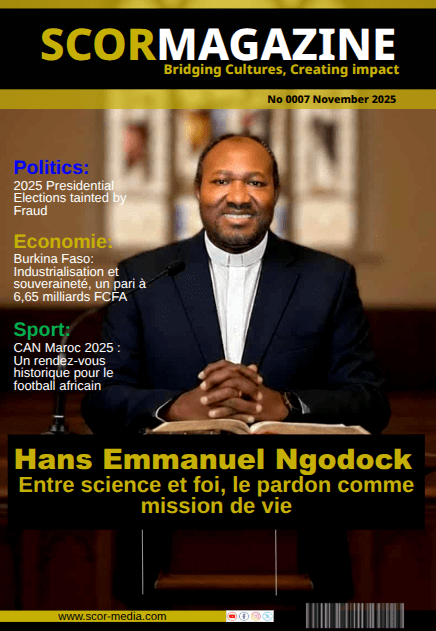
SCOR MAGAZINE No. 3: When Culture Becomes the Reflection of Cameroon’s Tensions

The third issue of SCOR MAGAZINE is for you. It is essential for anyone who wishes to understand the deep dynamics shaping Cameroon today. The country stands at a crossroads. It is caught between cultural exaltation and a creeping political crisis. This issue makes the bold choice to place art and culture at the heart of the debate.

In this highly tense election year, artists have become the last free orators. Their works, stages, and voices show the social and political realities. SCOR presents a special feature on the emblematic clash between Maahlox and Kocee. They explore much more than just a simple rivalry. It examines a generational confrontation, a quest for authenticity, and ambitions.

The edition also pays tribute to musical icons like Petit-Pays and Ben Decca. They are unifying figures in a landscape often divided by politics. On the sports front, the symbolic showdown between SYNAFOC and FECAFOOT is embodied by Eto’o and Njitap. This showdown reveals the tensions permeating Cameroonian football. These tensions mirror the excesses of an authoritarian power.

This issue offers a clear-eyed analysis of the “7 deadly sins” of Maurice Kamto. She is a controversial political figure who fascinates many but also divides. The issue also looks at the Cameroonian diaspora in Australia. It is described as a fragmented community. It is full of dreams but faces many realities.

Finally, SCOR MAGAZINE invites readers on a cultural immersion with the KUNDE Company. They are the standard-bearers of Bantu rhythms. Afterward, there is an original detour to scalp care. This reminds us that sometimes, the essential lies where we least expect it.

This third issue is available online and through the network of SCOR MEDIA GROUP partners. It is addressed to everyone who wants to understand the contradictions. They can explore the hopes and strengths of a Cameroon in full transformation.

SCOR MAGAZINE No. 3 – Bridging Culture, Creating Impact

SCOR MAGAZINE N°3 : Quand la culture devient le reflet des tensions du Cameroun

Le troisième numéro de SCOR MAGAZINE est fait pour vous. Il est essentiel pour quiconque souhaite comprendre les dynamiques profondes qui façonnent le Cameroun aujourd’hui. Le pays se trouve à la croisée des chemins, pris entre une exaltation culturelle vibrante et une crise politique rampante. Ce numéro fait le pari audacieux de placer l’art et la culture au cœur du débat.

En cette année électorale particulièrement tendue, les artistes sont devenus les derniers orateurs libres. Leurs œuvres, leurs scènes et leurs voix reflètent les réalités sociales et politiques. SCOR consacre un dossier spécial au clash emblématique entre Maahlox et Kocee. Plus qu’une simple rivalité, il s’agit d’une confrontation générationnelle, d’une quête d’authenticité et d’ambitions.

Cette édition rend également hommage à des icônes musicales comme Petit-Pays et Ben Decca, figures de rassemblement dans un paysage souvent divisé par la politique. Sur le front sportif, le face-à-face symbolique entre le SYNAFOC et la FECAFOOT, incarné par Eto’o et Njitap, met en lumière les tensions qui traversent le football camerounais, reflet des dérives d’un pouvoir autoritaire.

Ce numéro propose une analyse lucide des « 7 péchés capitaux » de Maurice Kamto, figure politique controversée, à la fois fascinante et clivante. Il jette également un regard sur la diaspora camerounaise en Australie, décrite comme une communauté fragmentée, pleine de rêves mais confrontée à de multiples réalités.

Enfin, SCOR MAGAZINE vous embarque dans une immersion culturelle avec la Compagnie KUNDE, porte-étendard des rythmes bantous. Puis, détour inattendu vers le soin du cuir chevelu, comme pour nous rappeler que l’essentiel se cache parfois là où on ne l’attend pas.

Ce troisième numéro est disponible en ligne et à travers le réseau de partenaires de SCOR MEDIA GROUP. Il s’adresse à tous ceux qui veulent comprendre les contradictions, explorer les espoirs et révéler les forces d’un Cameroun en pleine transformation.

SCOR MAGAZINE N°3 – Bridging Culture, Creating Impact

Special Tribute to Jo

Some departures freeze time. Joseph Oyebog, fondly known as Jo, has passed away. His absence leaves an immense void in the hearts of all who crossed his path.

This special edition is dedicated to him.

He was not only a pioneer of Cameroonian tennis. He was also a mentor and a visionary. He was a man driven by passion and generosity. He planted seeds of hope, talent, and determination in the hearts of thousands of young people. Many of them owe him their first racket and their first dream.

We invite you to relive his journey, battles, and victories through these pages. Above all, we celebrate the legacy he leaves behind. Testimonials, stories, photos, and memories are in this issue as a heartfelt thank-you. They serve as a final gesture of gratitude to someone who gave us so much.

Jo is gone, but his work lives on. OTA continues. And we will never forget.

The SCOR MAGAZINE Editorial Team

Spécial Hommage à Jo

Il y a des départs qui figent le temps. Celui de Joseph Oyebog, affectueusement appelé Jo, laisse un vide immense dans le cœur de tous ceux qu’il a touchés. Ce numéro spécial lui est dédié.

Parce qu’il n’était pas seulement un bâtisseur du tennis camerounais, mais aussi un mentor, un visionnaire, une âme passionnée et généreuse. Parce qu’il a semé des graines d’espoir, de talent et de détermination dans le cœur de milliers de jeunes, dont beaucoup lui doivent leur première raquette et leur premier rêve.

À travers ces pages, nous vous invitons à revivre son parcours, ses combats, ses réussites, mais surtout l’héritage qu’il nous laisse. Témoignages, récits, images et souvenirs composent ce numéro comme un grand merci, un dernier service rendu à celui qui nous a tant donné.

Jo s’en est allé, mais son œuvre demeure. OTA continue. Et nous, nous n’oublierons jamais.

La Rédaction de SCOR MAGAZINE

SCOR MAGAZINE – Act 2: Cameroonian Excellence in the Spotlight

Your second issue shines a light on a rising star of Cameroonian tennis: Valerie Essome. Trained at the Oyebog Tennis Academy (OTA), this young prodigy now embodies the Cameroonian dream on American courts. With mental strength, determination, and pure talent, she proudly represents the Green, Red, and Yellow in the land of Uncle Sam. A living tribute to her late mentor Joseph Oyebog, who gave so much so that stars like Valerie could shine.

As the National Day of May 20th approaches, Mr. Collins takes us behind the scenes of the grand celebration held in Darwin, Australia. A mix of culture, patriotism, and national pride, the event left a lasting impression and strengthened the bonds within the diaspora.

Meanwhile, in Douala, the Lendi Fair is preparing for its second edition, even more ambitious than the first. On the agenda: innovations, exhibitions, local flavors, and youth initiatives to boost Cameroon’s cultural and economic fabric.

The month of May is also dedicated to the celebration of journalism. In Douala, Herve Junior Menom’sGolden Classes” held their 4th edition, focusing on skill-building and passing on professional excellence to passionate young media enthusiasts.

On the hair care front, VV-Jo shares her top hydration tips for healthy, radiant hair. A must-read wellness moment to add to your daily routine.

Finally, in our Society & Reflection section, Eric Cyr offers a moving analysis of the paradoxical distrust some members of the Cameroonian diaspora hold towards their own initiatives. A powerful piece that calls for introspection and reconciliation.


SCOR MAGAZINE – Act 2 is a celebration of talent, reflection, and African pride. Stay tuned, the positive revolution continues!

SCOR MAGAZINE – Acte 2 : L’Excellence Camerounaise en pleine lumière

Votre deuxième numéro met à l’honneur une figure montante du tennis camerounais : Valérie Essome. Formée à Oyebog Tennis Academy (OTA), cette jeune prodige incarne aujourd’hui le rêve camerounais sur les courts américains. Entre force mentale, détermination et talent pur, elle fait rayonner avec fierté les couleurs Vert, Rouge et Jaune au pays de l’Oncle Sam. Un hommage vivant à Joseph Oyebog, son mentor récemment disparu, qui aura tant donné pour que des étoiles comme Valérie brillent.

À l’approche de la Fête nationale du 20 mai, M. Collins nous a emmène dans les coulisses de la célébration grandiose organisée à Darwin, en Australie. Entre culture, patriotisme et fierté identitaire, l’événement a marqué les esprits et renforcé les liens de la diaspora.

Pendant ce temps, à Douala, la Foire de Lendi prépare sa 2ᵉ édition, encore plus ambitieuse. Au programme : innovations, expositions, saveurs locales et initiatives jeunes pour dynamiser le tissu économique et culturel camerounais.

Le mois de Mai est également celui de la consécration du journalisme. À Douala, les Classes en Or de Hervé Junior Menom ont tenu leur 4ᵉ édition, avec un accent mis sur le renforcement des compétences et la transmission de l’excellence professionnelle à la jeunesse passionnée des médias.

Côté santé capillaire, VV-Jo vous livre ses astuces d’hydratation pour une chevelure éclatante et en pleine forme. Un rendez-vous bien-être à ne pas manquer dans votre routine quotidienne.

Enfin, dans notre rubrique Réflexion & Société, Éric Cyr vous propose un décryptage poignant sur cette méfiance paradoxale que nourrit une partie de la diaspora camerounaise envers ses propres initiatives. Un texte fort, qui invite à l’introspection et à la réconciliation avec soi-même.


SCOR MAGAZINE – Acte 2 est un condensé de talents, de réflexions et de fiertés Africaines. Restez connectés, la révolution positive continue !

SCOR MAGAZINE – L’âme d’une diaspora, la force d’un héritage

Dans ce nouveau numéro de SCOR MAGAZINE, nous vous invitons à un véritable voyage au cœur d’une diaspora africaine vibrante, résiliente et profondément engagée. À travers des récits authentiques, des analyses tranchantes et des portraits inspirants, notre équipe vous propose un regard neuf sur les enjeux et les réussites qui façonnent notre communauté à travers le monde.

Découvrez l’histoire fascinante de Simon Bell, figure emblématique au parcours légendaire. Plongez dans l’univers engagé de Franck Ghislain Onguene, qui décrypte avec lucidité l’état critique du football camerounais. Laissez-vous surprendre par l’art capillaire mis en lumière par Vivi Jo, un hommage à la beauté et à la créativité afro.

Côté saveurs, Pamsi’s Delicacies vous emmène à la découverte de la richesse culinaire camerounaise à Sydney, tandis que Wax Dey nous partage les coulisses de l’ascension fulgurante de l’Afropop sur la scène mondiale. Et pour finir, ne ratez pas notre focus sur Darwin en feu, l’événement phare de ce mois, ainsi que la chronique percutante d’Eric Cyr sur les réalités migratoires.

SCOR MAGAZINE, c’est bien plus qu’un magazine. C’est une voix. La vôtre. La nôtre.

Bonne lecture !

SCOR MAGAZINE – The Soul of a Diaspora, the Strength of a Legacy

In this new issue of SCOR MAGAZINE, we invite you on a journey through the heart of a vibrant, resilient, and deeply committed African diaspora. Through powerful stories, sharp analysis, and inspiring portraits, our team offers a fresh perspective on the challenges and achievements shaping our global community.

Dive into the inspiring journey of Simon Bell, a legendary figure whose story transcends generations. Read Franck Ghislain Onguene’s bold take on the urgent need to reform Cameroonian football. Be moved by Vivi Jo’s exclusive piece on hair artistry as a tool of identity and creativity.

On the culinary side, Pamsi’s Delicacies shares the rich flavors of Cameroonian cuisine from Sydney. Music icon Wax Dey reveals the secret behind Afropop’s global breakthrough, while Darwin en feu promises to be the standout event of May. Finally, don’t miss Cyr Eric’s compelling column on migration issues.

SCOR MAGAZINE is more than just a magazine. It’s a voice. Yours. Ours.

Happy reading!

Technological Innovations in Visual Journalism

By Sylvain Kwambi

Once constrained by heavy, costly equipment requiring complex technical setups, journalism has evolved significantly thanks to technological advancements. Visual journalism, which relies on capturing, processing, and disseminating visual information, has experienced groundbreaking progress that not only facilitates the work of reporters but also enhances the quality and responsiveness of news imagery like never before. The early 2010s marked a turning point in this transformation, particularly with the rise of drones, mobile journalism (MoJo), and the integration of artificial intelligence (AI). These innovations have opened new possibilities in image capture, accessibility, and content processing. This article explores these technological breakthroughs, highlighting their impact on visual journalism.

Drones have revolutionised visual journalism by providing spectacular aerial shots at a fraction of the cost of traditional methods. Before their democratisation, journalists had to rely on helicopters or cranes, both expensive and logistically demanding options. By the early 2010s, media organisations began adopting high-definition camera-equipped drones. In 2013, the BBC and CNN used them to cover conflicts and natural disasters. In 2016, the FAA introduced regulations to govern drone usage, further facilitating their adoption. By the 2018 FIFA World Cup in Russia, drones had become a staple, offering unprecedented panoramic views.

Drones enable journalists to access difficult or dangerous areas while providing innovative perspectives. Thanks to technological advancements, they now offer superior image stabilisation and real-time transmission, enhancing viewer immersion. However, their use presents challenges: regulations vary by country, and restricted flight zones exist. Additionally, privacy concerns remain a significant issue. Despite these constraints, drones have established themselves as an essential tool in modern journalism, with promising future developments.

Mobile journalism, or MoJo, involves using smartphones and mobile tools to film, edit, and broadcast reports in real time. This shift has been made possible by advancements in smartphone camera technology and the development of powerful editing applications.

MoJo gained traction in 2014 when Swedish broadcaster SVT produced the first iPhone-based news reports. By 2016, the BBC had launched a training program to teach its journalists how to create content using smartphones, granting them greater autonomy in the field. The primary advantage of MoJo is portability: a smartphone equipped with a stabiliser and a lavalier microphone is sufficient to produce professional-quality videos. Apps like LumaFusion and Filmic Pro enable fast editing, significantly reducing production time.

MoJo also facilitates real-time broadcasting via platforms such as Facebook Live and YouTube Live, making news more immediate and interactive. However, it has limitations, particularly regarding image quality in low-light conditions and credibility concerns. Despite these challenges, MoJo has become an indispensable tool, especially for digital media and social networks.

Artificial intelligence (AI) is playing an increasingly significant role in visual journalism by streamlining content analysis, editing, and automated distribution. Since 2018, tools like Reuters’ Lynx Insight have enabled journalists to process vast amounts of visual and textual data efficiently, optimising their workflow.

AI is also being used for image creation and manipulation through software such as DALL·E and MidJourney, although these technologies raise ethical concerns regarding misinformation and visual credibility. Additionally, AI enhances video quality by stabilising footage, up-scaling resolutions, and generating automatic subtitles. In 2022, NBC News implemented a real-time subtitle system, improving accessibility for a wider audience.

Despite these advancements, AI-driven journalism poses challenges related to verification and ethics. Journalists must remain vigilant about image authenticity and the risks of manipulation. While AI represents a revolution in visual journalism, its use must be carefully regulated to maintain information reliability.

Technological innovations have profoundly transformed visual journalism, equipping reporters with more efficient and accessible tools. The rise of drones, the development of mobile journalism, and the integration of artificial intelligence have enabled visual journalists to become more autonomous, swift, and effective. However, these advancements also bring challenges, particularly concerning regulation and journalistic ethics.

In an era where visual content plays a crucial role in news dissemination, these technologies will continue to evolve, constantly redefining the practices of visual journalism.

Photo: https://journalismcentral.com/?p=1152

Media and Social Networks: How the Journalist Must Stand Out from the Influencer

By Sylvain Kwambi

The rise of social media has profoundly transformed journalistic practices, changing the way information is disseminated, produced, and consumed. Real-time coverage of events has become increasingly popular, thanks to formats like short videos and tweets. This spontaneity has reduced the time it takes to transmit information while democratising its production, with citizens contributing to journalism through platforms like Twitter or Instagram. Social media has also changed the economic models of media, with a loss of advertising revenue to platforms like Facebook and Google, pushing newspapers to adapt through digital subscriptions or collaborations.

Unlike an influencer, who focuses on creating engaging content, often with commercial motivations, a good journalist distinguishes themselves through several key elements that reflect integrity, rigor, and responsibility in handling information. Here are six elements that should mark this distinction:

1-Objectivity and Impartiality:

image: https://izea.com/resources/journalists-and-news-influencers/1

A journalist strives to present facts in a balanced way, without bias. The goal is to inform precisely and comprehensively, giving voice to all parties involved. In contrast, an influencer may have marked personal opinions and express subjective judgements, often influenced by commercial partnerships or a specific audience.

2-Fact-Checking:

Image: https://centrafriquecheck.org/centrafrique-check-celebre-la-journee-internationale-du-fact-checking/

Journalists follow strict protocols for verifying information before dissemination, cross-checking sources and validating data. Influencers, on the other hand, may sometimes spread unverified or sensational information for the sake of attractive content, without the same level of rigor.

3-Professional Ethics:

Image : https://nationalpress.org/topic/why-journalism-ethics-need-a-major-reckoning-too/

A good journalist adheres to a code of ethics, which includes transparency about sources, avoiding conflicts of interest, and respecting individuals’ privacy. Influencers, while they may have personal ethics, are not held to the same professional standards, and their relationships with brands can influence the way they communicate.

4-Depth of Analysis:

Image: https://www.bark.us/blog/social-media-influencers/

A journalist’s work involves an in-depth analysis of the subjects they cover, providing an informed and thoughtful perspective. Influencers, in their communication, often prioritise lighter, entertaining, or promotional content, with a lack of deep critical analysis.

5-Social Responsibility:

image: https://shorensteincenter.org/building-compelling-value-propositions-for-digital-media-subscriptions-and-memberships/

A journalist is aware of their role in society and considers the consequences of their words on the public. They aim to enlighten readers on social, political, or economic issues. While influencers also have an impact on their audience, their approach is more entertainment-oriented or product promotion-focused, and they may sometimes neglect the social impact of their messages.

6-Long-Term Commitment:

Image: www.freepik.com

A journalist typically works in a sustainable manner, building long-term credibility with their audience. This includes a relationship of trust and respect, based on the quality and consistency of their work. Influencers, on the other hand, may be more focused on immediate success and engagement with their community on specific platforms, sometimes with a more opportunistic approach.